Category: Basis

Basic managerial and leadership issues

  • 🌧️ “Managers define the what. Leaders define the why.”

    He sat across from me

    white shirt, sleeves rolled up,

    eyes tired from leading,

    but long disconnected from why he was doing it.

    The office smelled like coffee after an all-nighter.

    The whiteboard behind him was covered with arrows, charts, goals

    all pointing upward.

    Except him.

    “I’m pushing the team hard,” he said.

    “If I don’t, they don’t move.”

    His voice was firm,

    but something in his eyes trembled.

    So I asked quietly

    the way you hold up a mirror to someone

    who hasn’t looked at themselves in a while:

    “Tell me… are they really running toward the goal,

    or just running away from you?”

    Silence.

    Even the fan seemed to stop spinning,

    as if it didn’t want to interrupt.

    Then came a small, tired smile

    the kind that admits the truth

    without saying a word.

    It took him a while,

    but eventually he stopped measuring success by speed

    and started measuring it by meaning.

    Not how much they achieved,

    but why it mattered.

    And slowly…

    the office filled again

    with laughter,

    with the scent of creativity,

    with that quiet rhythm

    of people who have a reason to wake up in the morning.

    Because pressure might move people,

    but inspiration makes them want to move.

    And that’s the difference

    between someone who manages

    and someone who leads.

    💭 So tell me

    when you set goals for your team,

    do they feel pressure… or purpose?

  • 🌌 Luke Skywalker Wasn’t Born a Jedi

    (and you don’t have to be born a manager either)

    Imagine Luke Skywalker trying to save the galaxy…

    without ever meeting Yoda.

    He’d still be a nice farm kid with a big dream

    and a lightsaber with no batteries 😅

    but absolutely no idea how to use the Force.

    And honestly?

    The world of management isn’t that different.

    I still remember my early days as a manager

    motivation sky-high, a team around me,

    and a heart that wanted to make a difference.

    But…

    no real understanding of what it meant to lead.

    How do you build trust?

    How do you set boundaries without breaking people?

    How do you handle conflict without burning bridges?

    No one really teaches you that.

    You just get thrown into the deep end

    and hope you don’t run out of oxygen.

    Then one day, it hit me

    leadership isn’t magic.

    It’s not “natural charisma.”

    It’s a system.

    And a system?

    You can learn.

  • Management Is a Masterclass in Letting Go

    You know what’s the most frustrating thing about being a manager?

    Even when you’re right it doesn’t always help. 😅

    Because management isn’t about control.

    It’s a lifelong practice in letting go.

    Not the chaotic kind

    but the kind that’s built on trust.

    And don’t say no one warned you…

    There were days when I delegated a task

    and everything went exactly as I imagined.

    (Yes, it happens like a solar eclipse once a decade.)

    And there were other days

    when delegation felt like a science experiment gone wrong.

    Papers everywhere, phones ringing,

    and me staring at the screen,

    smelling the virtual smoke of a burning deadline.

    But then there are the surprising moments

    when I delegate, thinking I know exactly how it should look,

    and the team takes it somewhere completely different.

    Not like mine. Not by the book.

    But… better.

    That mix of relief and pride?

    It’s like taking your hands off the wheel

    and realizing the car keeps going straight.

    Here’s something no leadership course will tell you:

    Real leadership is about releasing control wisely.

    Not to everyone, not all the time.

    But to the right person, for the right task,

    and then giving them room to breathe.

    Because when a manager tries to control everything,

    they eventually lose control of themselves.

    But when a leader gives trust,

    they discover the world keeps moving

    even when they stop holding on so tightly.

    💡 Manager’s Tip

    Next time you delegate, leave a little room for surprise.

    Someone on your team might just show you a better way.

    👀 Your turn:

    How much space do you leave

    for others to surprise you

    not your way,

    but theirs?

  • How Not to Become Your Team’s Personal Tech Support Line

    Let’s be honest,

    if every little question keeps bouncing back to you,

    you’re not managing…

    you’re basically a walking version of Google.

    (Just without the search engine or Incognito mode 😅)

    But here’s a simple practice

    that can break that loop once and for all:

    Next time someone comes to you with a question,

    instead of firing off an instant answer,

    try one of these three responses:

    “What do you think we should do?” “What options do you see?” “What did you learn from this for next time?”

    These three questions work like magic.

    They put the ball back in your employee’s court,

    get them thinking,

    and send a clear signal:

    I trust you to figure this out.

    At first, it’ll take some restraint.

    (Feel free to bite your lip or sip your coffee slowly

    especially if you’re mid-Zoom call 😉)

    But soon enough,

    you’ll notice a shift.

    They’ll start showing up with solutions,

    not just problems.

    And you?

    You’ll finally feel like you’re managing people

    not running the company’s help desk.

    So tell me

    which of these three questions

    are you going to try first thing tomorrow morning?

  • How to Measure Your Impact as a Manager (Even When You Didn’t Move a Single Screw)

    Ever have one of those days?

    Everyone around you seems busy.

    Typing away, making calls, checking boxes.

    And you?

    You head home after a day full of meetings,

    kick off your shoes,

    and ask yourself:

    “What did I actually do today?”

    Here’s a little trick:

    At the end of each day, ask yourself three simple questions:

    What direction did I set or help clarify today? What obstacle did I remove for my team? Who walked away from a conversation with me feeling more energized or confident than before?

    Write it down, in a notebook, an app, wherever.

    Give it a name.

    Even just one line.

    You’ll be surprised how quickly you start to see

    that your contribution is no less real

    than the person who finished another spreadsheet or tightened a few bolts.

    It’s just a different kind of work.

    Management isn’t about what you did.

    It’s about what you enabled others to do.

    So tell me,

    when tomorrow ends,

    what’s one small win you’ll write down for yourself?

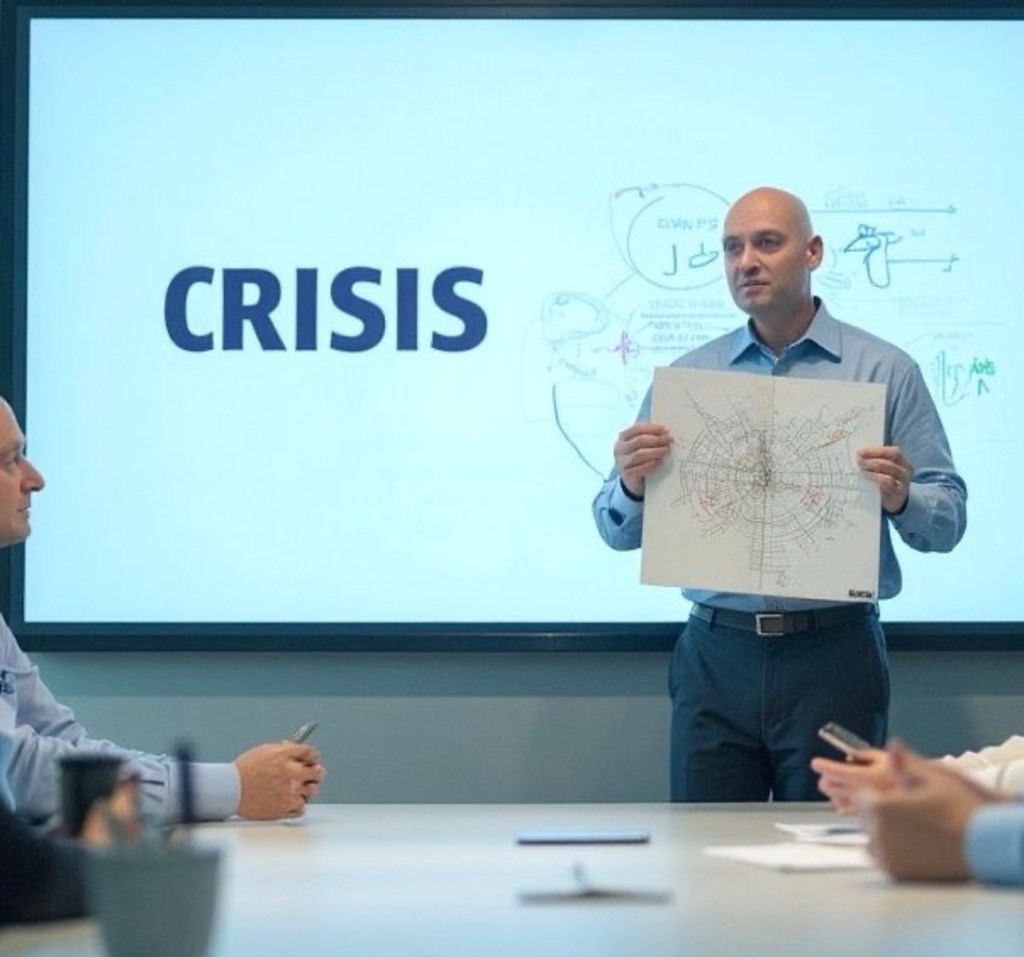
  • “Welcome to the Daily Crisis Club Manager’s Edition”

    Membership? Free.

    Enrollment? Automatic, the day you get the title.

    Activities? Live-action crises, ever-changing,

    with reruns scheduled at the most inconvenient times.

    You plan a calm day,

    knock out your to-do list,

    finally drink a cup of coffee while it’s still hot…

    and then life taps you on the shoulder and says:

    “Sweetheart, sit down. Let us show you what a real crisis looks like.”

    Here’s the greatest hits list:

    Business Crisis Your biggest client announces they’re moving to a competitor. (And just to spice it up… they do it at a press conference.)

    PR Meltdown A viral post on X (Twitter) with 300 shares: “Don’t buy from them look what I got!” Customer service lines are on fire, and your heart rate’s at 180.

    Health & Safety Scare Emergency call: “There’s a gas leak at the plant.” Of course, it’s the same day the CEO’s visiting for a tour.

    Cyberattack Morning: business as usual. By lunch: every screen flashes pink with a message “Pay in Bitcoin or kiss your files goodbye.”

    Operations Breakdown A truck with a critical shipment breaks down 120 miles from its destination. The driver? Not picking up. GPS? Says he’s in the middle of a cornfield.

    Financial Shock Monthly report. Bottom line in red. Very red. Almost as red as your face when you present it to the board.

    HR Bombshell Your team’s star performer quits. Effective Monday. No handover.

    Environmental Mess Heavy rain. Warehouse flooded. And then you discover “insurance” has a lot of fine print.

    Internal Reputation Hit Rumor spreads you’re leaving your role. (And you hear it first from the security guard in the lobby.)

    Innovation Flop New product launch. Customer feedback: “Oh… we already had this two years ago.”

    The tip?

    Crisis management isn’t about if, it’s about when.

    So expect them, build your playbook,

    and walk in with humor and a mindset that carries your whole team.

    Because if you’re stressed, they’re twice as stressed.

    But if you stay calm, they’ll know you can all get through it.

  • “The Only Engineer in a World of Managers”

    A boardroom.

    Twenty managers in crisp, corporate-blue dress shirts,

    standard charcoal-gray slacks,

    and body language that said, “We were born to lead.”

    And then there was me.

    Jeans, a bargain shirt from the outlet mall,

    and a face that said, “Did someone invite me here by mistake?”

    Back then, I was the only engineer

    in a world of managers.

    There was no promotion track for engineers.

    The only way forward

    was to cross over into management.

    So when a management position opened up,

    I wanted it, badly.

    But instead of giving me the chance,

    they hired someone from the outside.

    Why?

    Because I was a “great engineer”…

    but not a manager.

    It was like telling a chef

    his food is extraordinary

    but he’s not qualified to run a kitchen.

    That’s when it hit me:

    In organizations, being good at your craft isn’t enough.

    You have to project leadership potential

    long before you get the title.

    Ever felt like you were ready to take the next step,

    only to watch someone else leap ahead of you?

  • “We Sat. We Talked. We Almost Threw Punches.”

    Okay, not really.

    But you know that silence in a meeting

    when everyone’s eyes are screaming?

    I was leading a brand-new management team.

    Some were seasoned veterans with tons of experience.

    Others were new, sharp, hungry.

    A winning mix?

    On paper, yes.

    In practice? More like putting peanut butter on sushi—interesting, but… it doesn’t exactly go down easy.

    There were arguments.

    Drama.

    Hallway chatter.

    Small tensions that turned into big stories.

    Every discussion felt like a fight.

    Every decision, a vote of no confidence.

    Something had to give.

    And then something simple happened:

    we opened a process.

    Not a box-checking, corporate exercise.

    A real one.

    One that taught us how to give feedback.

    How to stop shooting and start talking.

    Feedback not as a reaction, but as a tool.

    Not just to vent, but to move things forward.

    Slowly, things shifted.

    The energy balanced out.

    Fights turned into conversations.

    The cynicism cooled down.

    And those eyes stopped screaming.

    The insight?

    Conflict doesn’t disappear.

    It just changes form.

    And when people learn how to argue,

    they also learn when to compromise.

    So here’s the question:

    Does your team know how to fight to get stronger?

    Or are they just fighting?

  • “How I Burned a Million Dollars”

    A few years ago,

    I was convinced I was making a smart move.

    We invested one million dollars in an automation project.

    Yes, a million.

    I had a clear goal:

    to prove that automation could work at scale.

    And honestly? I was so determined

    that I jumped at the opportunity without really checking

    if the system was the right fit.

    I rushed.

    I skipped critical evaluation and testing.

    My head said, “Move fast.”

    My heart said, “This is the future.”

    But no one stopped to ask:

    What if it doesn’t deliver?

    The day we launched it,

    it needed… training wheels.

    An entire team had to patch, workaround, and push it forward.

    It never really “ran” on its own.

    And after a few years,

    we ended up replacing it entirely with a new system.

    My leadership takeaway:

    When you’re in a hurry to prove a point,

    you can pay a heavy price.

    Pause. Ask the uncomfortable questions.

    Do the deep due diligence before making a big call.

    Because sometimes, moving too fast costs far more than the investment itself.

  • “She didn’t ask me to write this. But I just can’t stay quiet.”

    Every evening she comes home exhausted.

    She gives everything she has.

    Carries projects on her shoulders that would crush most people.

    And it’s not just performance.

    It’s brains, empathy, intuition, responsibility, big-picture thinking

    everything you’d want in a leader, she’s got it.

    But then the message comes:

    So-and-so got promoted.

    Not her.

    And it happens again.

    And again.

    She smiles.

    Says, “It’s okay.”

    That what really matters is working on something meaningful.

    That the title doesn’t matter as much as the impact.

    And me?

    I’m boiling inside.

    Because I see her worth.

    And I don’t understand

    why others can’t see it.

    Then I start to wonder:

    Maybe she doesn’t push herself forward enough?

    Maybe she doesn’t “market” herself?

    Maybe she just does the job too well,

    so it’s easier to keep her exactly where she is?

    But it hurts.

    Because I know it’s not her fault.

    And I also know

    that one day, they’ll finally wake up.

    And by then…

    it might be too late.

    My takeaway?

    Sometimes, to move up,

    it’s not enough to be amazing.

    You also have to remind people of it—without shame.

    Are you doing that?