Category: Lean

Lean Management

  • Post Number 1 on Continuous Improvement and Lean Management: The PDCA Cycle – The Fundamental Tool for Continuous Improvement

    We believe it is important to write about the topic of continuous improvement and lean management. We have created a series of posts on this subject that connect and link the PDCA cycle to all lean management tools.

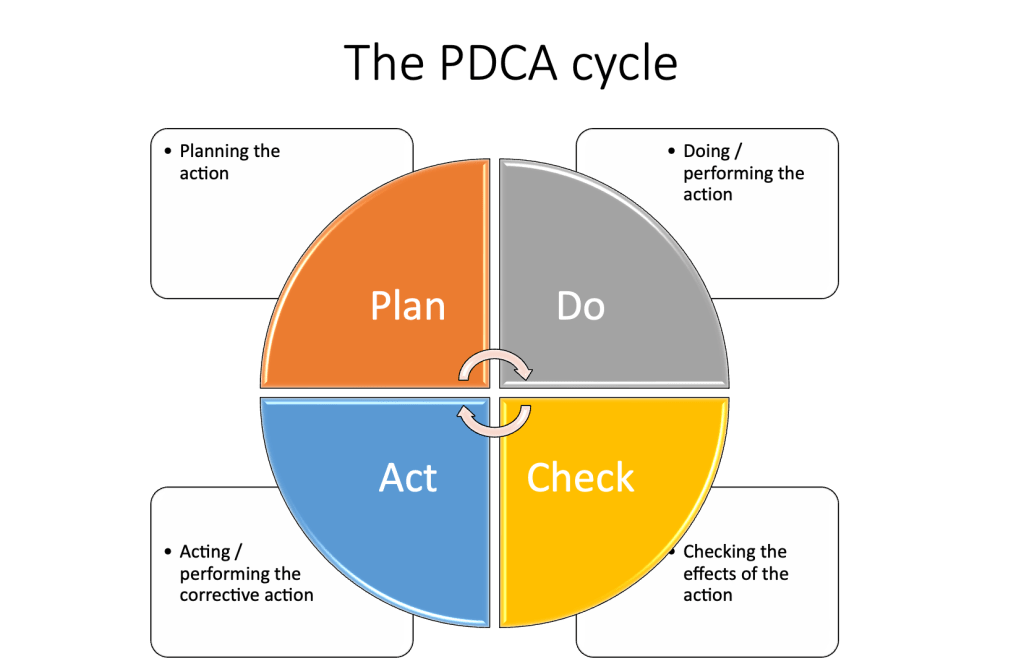
    The PDCA cycle for continuous improvement is a powerful management tool designed for continuous improvement in processes and operations within organizations. This cycle consists of four stages:

    1. Plan: In this stage, the problem or improvement opportunity is identified, the current situation is analyzed, data is collected, and an action plan is prepared. This is a critical stage where clear goals must be defined and the most suitable solutions chosen.

    2. Do: In this stage, the plan created in the planning stage is implemented. It is important to perform the actions in a controlled manner and document the entire process to allow for evaluation and follow-up later.

    3. Check: In this stage, the results of the implementation are evaluated. The actual performance is compared to the goals defined in the planning stage, and it is analyzed whether the achieved improvement meets the expectations. It is important to identify both successes and failures to learn from them and improve.

    4. Act: In this stage, decisions are made on the next steps based on the findings from the check stage. If the achieved improvement is sufficient, the changes can be embedded as part of the regular process. If not, corrections should be made, and the cycle should be repeated.

    For example, a customer service department can use the PDCA cycle to improve response times to customer inquiries. In the planning stage, they would identify the causes of delays, conduct an in-depth analysis, and prepare an improvement plan. In the doing stage, they would implement solutions such as assigning additional staff or changing the work process. In the checking stage, they would measure the new response times and check if the improvement meets the goals. In the acting stage, they would decide whether the changes made are sufficient or if further improvements are needed.

    In the upcoming posts, we will discuss additional lean management tools and how the PDCA cycle is applied to them.

  • Trust


    In the next few posts, I plan to write about several issues which are in my opinion, the basis of management.

    I believe that trust is the baseline of every relationship, thus, trust is also the basis of every managerial relationship or leadership . It doesn’t matter whether you lead a single person (a one on one connection) or a team, trust is the first thing you’ll have to build, and maintain.

    I usually make a distinction between different levels of trust:

    1. At the first level stands what I call “Personal trust”, this is the basic level of trust between two people. To achieve this level of trust, people usually should at least know each other enough, so they understand in the most general terms, which common values they share and which they don’t agree upon. The best way to bring people to this level of trust is to make them spend some time together. A good way to speed up the process would be to facilitate a meeting with personal introductions and activities that will make each partner expose more information about himself (his personal life, his family, hobbies, beliefs etc.).
    The “Personal trust” is about knowing the other person / people on a personal level and being able to authentically respect at least some of his / her personal traits.

    2. At the second level stands what I call “Professional trust”; this is the belief that the other person is capable of performing the task at hand. The best way to build trust to this level is to give the involved parties an opportunity to watch the others perform their tasks. This usually require some time, so that each one has the chance to witness the other performing and getting the job done several times.
    The “Professional trust” is about believing that the other person is capable of doing his job.

    3. The third level is what I call “Mutual goal trust” or “Mutual mission trust”, this is the belief that the other person is committed to the same goal or mission that I’m committed to, and even better, that we share our views on how to achieve this mutual goal. In order to reach this level of the trust the involved parties should spend time to agree upon and clarify both mission and the path to get it.

    Often you’ll meet groups of people that didn’t go through all the above mentioned phases of trust. You might hear a sentence like “He’s a good guy but I’m not sure he’d be capable to help me” – achieved level one of trust but not level two. Or “I don’t trust this guy but he is surely a pro” – level two achieved while level one is missing.

    I sincerely believe that in order to get the best possible performance at any given task or mission, whether it’s you with your only subordinate Joe, or a leader with many followers, one must go through all three levels of building trust.

    That’s it for today,
    HoM (that is “Heart of Management”)