
Tag: attitude

  • 💔 Turns out the opposite of courage… isn’t fear at all

    (Yes, and I learned this from a woman with a tattoo.)

    The Zoom call started like any other one.

    Camera on.

    Hot coffee in hand.

    And then she appeared on screen.

    A senior education leader.

    Responsible for the professional development of over 6,000 teachers.

    And from the very first moment, it was clear:

    this was someone you couldn’t ignore.

    Sharp presence. Big smile.

    A tattoo on her arm (and that’s where I paused, I didn’t ask what it said).

    And a feeling in the room like

    someone had just opened a window after a very long day.

    She didn’t raise her voice.

    But she was the kind of person who walks into a room

    and the noise instinctively pulls up a chair.

    We talked about leadership. About change.

    About what actually holds people together from the inside.

    And then she said something simple:

    “The opposite of courage?

    It’s not fear.

    It’s avoidance.”

    One of those sentences that makes you stop mid-sip.

    Fear is loud.

    You can feel it. You can name it.

    Avoidance is quiet.

    It slips under the radar.

    It doesn’t shout, it whispers.

    And it shows up in a manager’s life

    long before they realize what’s happening…

    stealing years of growth and effectiveness along the way.

    Then she added one more thing:

    “There are three kinds of courage.”

    And that’s where the connection became mine.

    Managerial.

    Deep.

    She only named them.

    My mind filled in the rest:

    🩵 The courage to speak up

    Truth. Authenticity. Navigating organizational politics

    without paying unnecessary prices.

    🩵 The courage to trust

    Letting go. Delegating.

    Stopping yourself from holding 357 tasks with two hands.

    🩵 The courage to experiment

    Innovation. Mistakes. Learning. Change.

    Actually moving reality—not just moving the cursor.

    And suddenly it all snapped into focus:

    “Managerial stuckness” isn’t personality.

    It’s not workload.

    It’s not character.

    It’s usually one form of courage

    that’s been left unattended for too long.

    So before you scroll on

    Do a quick internal audit:

    Which kind of courage

    are you most actively avoiding?

    Because right there

    exactly there

    your next big leadership shift begins.

    📌 Next week, I’ll open up the first one: the courage to speak up.

    And I promise it will change how you see your team, your boss,

    and yourself.

    📌 And by the way… there’s one more kind of courage.

    Just as deep.

    The courage to change.

    That one deserves a post of its own.

    (Hint: it’s the habits managers pay the highest price for.)
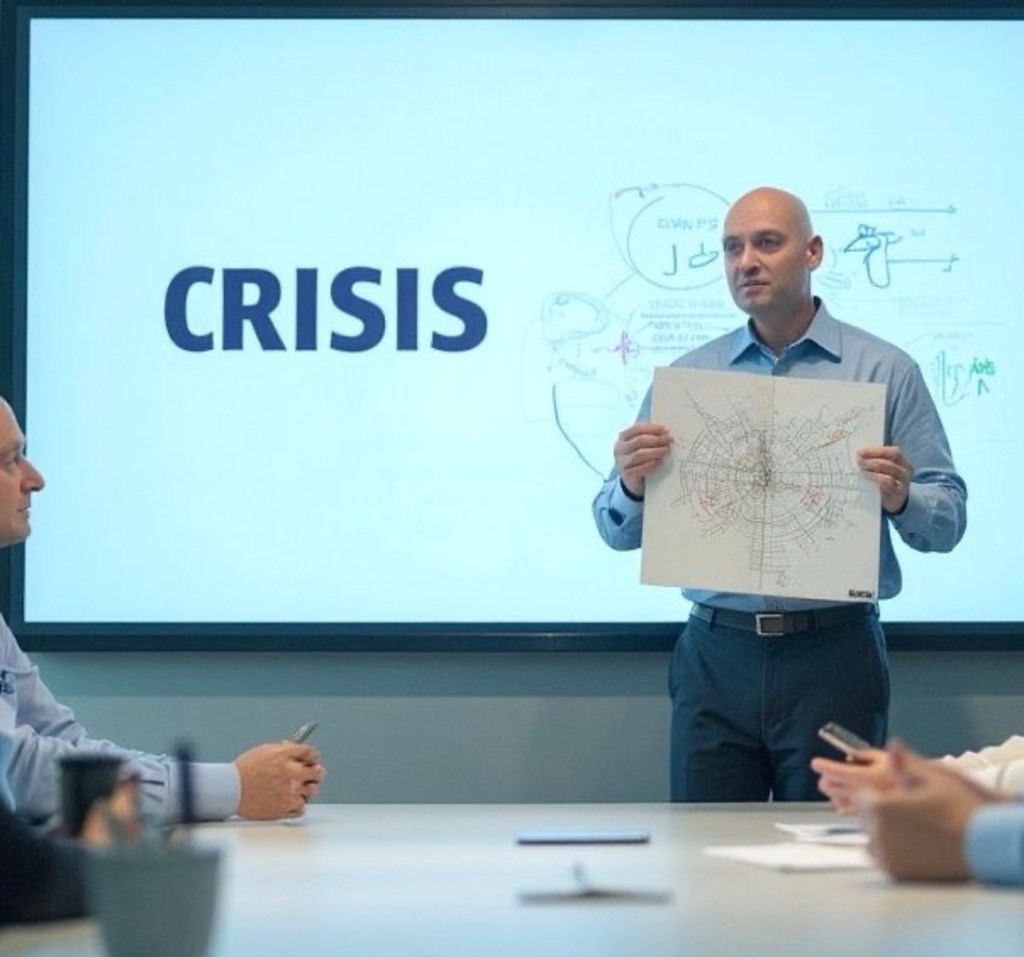
  • “Welcome to the Daily Crisis Club Manager’s Edition”

    Membership? Free.

    Enrollment? Automatic, the day you get the title.

    Activities? Live-action crises, ever-changing,

    with reruns scheduled at the most inconvenient times.

    You plan a calm day,

    knock out your to-do list,

    finally drink a cup of coffee while it’s still hot…

    and then life taps you on the shoulder and says:

    “Sweetheart, sit down. Let us show you what a real crisis looks like.”

    Here’s the greatest hits list:

    Business Crisis Your biggest client announces they’re moving to a competitor. (And just to spice it up… they do it at a press conference.)

    PR Meltdown A viral post on X (Twitter) with 300 shares: “Don’t buy from them look what I got!” Customer service lines are on fire, and your heart rate’s at 180.

    Health & Safety Scare Emergency call: “There’s a gas leak at the plant.” Of course, it’s the same day the CEO’s visiting for a tour.

    Cyberattack Morning: business as usual. By lunch: every screen flashes pink with a message “Pay in Bitcoin or kiss your files goodbye.”

    Operations Breakdown A truck with a critical shipment breaks down 120 miles from its destination. The driver? Not picking up. GPS? Says he’s in the middle of a cornfield.

    Financial Shock Monthly report. Bottom line in red. Very red. Almost as red as your face when you present it to the board.

    HR Bombshell Your team’s star performer quits. Effective Monday. No handover.

    Environmental Mess Heavy rain. Warehouse flooded. And then you discover “insurance” has a lot of fine print.

    Internal Reputation Hit Rumor spreads you’re leaving your role. (And you hear it first from the security guard in the lobby.)

    Innovation Flop New product launch. Customer feedback: “Oh… we already had this two years ago.”

    The tip?

    Crisis management isn’t about if, it’s about when.

    So expect them, build your playbook,

    and walk in with humor and a mindset that carries your whole team.

    Because if you’re stressed, they’re twice as stressed.

    But if you stay calm, they’ll know you can all get through it.

  • Quick change? That only works in a microwave.

    Consultants flew in from overseas.

    Slick slides.

    A big vision.

    A one-year plan and voilà! Operational excellence.

    Sounds impressive, right?

    But then I looked around.

    My people were barely keeping up with the day-to-day.

    Line breakdowns.

    Customers pushing hard on the phone.

    Marketing pushing discounts.

    Sales making promises we couldn’t deliver on.

    And in the middle of all that?

    Learn a whole new system?

    Change the entire workflow?

    Achieve excellence?

    I told myself:

    “They saw the plan.

    I see the people.”

    And I really saw them.

    Running from meeting to email,

    Exhausted. Confused. Stressed.

    Going through the motions of change just trying to survive the day.

    So I did something no management book teaches.

    I opened the contract.

    I scaled back the consulting.

    And I extended the timeline by a year and a half.

    Yes, a year and a half.

    Because real change doesn’t happen under pressure.

    There are no magic tricks.

    You can’t buy it in a deck of slides.

    Real change happens

    when the pace matches the heartbeat of your organization.

    Ever tried to push a change too fast

    and the system just spit it back out?

  • Got a “good” question? Ask it.

    Even if you’re the manager.

    Especially if you’re the manager.

    You know that moment in a meeting when someone drops a term…

    And your whole body signals:

    “Of course. Of course I know what CAC is. I’m the manager, after all.”

    But your mind goes:

    “If someone shouts at me right now ‘What’s CAC?’ – I’ll just head out for a coffee break and never come back.”

    So you smile, jot something down in your notebook (even though you have no idea what you wrote),

    And later that evening, you ask Google.

    Or your kid.

    Or ChatGPT.

    And that’s exactly the moment you missed the chance to be a more human manager.

    Because the gap wasn’t in knowledge it was in the courage to ask.

    A simple question like:

    “Could you explain that for a second?”

    Can change the entire dynamic of a meeting.

    It shows you’re not projecting authority based on bravado – but trust.

    And it gives others permission to ask too.

    And in an age where even a dishwasher can define “digital marketing,”

    What sets you apart isn’t what you know.

    It’s your willingness to keep learning.

    And by the way? I have no idea what CAC is either.

    But I’m going to ask the chat.

    What’s worth remembering?

    The one who asks doesn’t look less smart.

    They just look like a sane manager.

  • A management tip (that I learned the hard way):

    If you start feedback with a “but” – you’ve already lost the conversation.

    I used to jump straight into feedback.

    Direct. Sharp.

    “Not accurate enough,”

    “I expected more,”

    “There’s a gap that needs to be closed.”

    From my side, it was just being straightforward.

    From their side?

    It felt like the end of the world.

    Then it hit me:

    Wait a second.

    I hate it when people start with that tone too.

    No one likes feeling like they have to defend themselves before they’ve even had their coffee.

    So I started differently.

    Something small.

    A sentence like:

    “I want to start with what worked well.”

    And that changed the whole tone.

    Not because I gave up on the feedback –

    But because I started with an open heart, not a pointing finger.

    It sounds simple,

    But it completely shifts the energy of the conversation.

    What’s worth remembering?

    The sharpest feedback is the kind that doesn’t feel like a knife.

    A good start leads to an ending someone can actually take with them.

    Good feedback is the kind the other person can truly absorb.

  • A visit to the production lines

    Once, during a routine visit to one of the production lines, I saw that the workers were struggling with a simple measurement.

    I stood on the side, noticed the confusion – and then stepped in.

    I showed them exactly how to measure.

    We solved it in two minutes.

    At the end of the day, I asked the consultant who was accompanying me:

    “So, how was I?”

    He looked at me and said:

    “Terrible.”

    I was shocked.

    “What do you mean? I solved the problem!”

    Then he said a sentence that changed everything I thought I knew about management:

    “You’re not supposed to solve problems.

    You’re supposed to teach others how to solve them.”

    And from that day on – I stopped being the hero who saves everyone.

    And started being the one who asks:

    “What do you think?” “How would you handle this?” “What did you learn from it?”

    At first, it took restraint.

    But later – it freed me.

    And it lifted them.

    A good manager isn’t measured by how much they know –

    But by how much they help others believe that they do.

  • About a decade ago – life pressed “Pause” on me.

    And not a small click.

    A long pause.

    I got sick.

    Badly.

    It was clear I’d need surgery.

    Complex. Long.

    Thirteen hours.

    When I woke up —

    I was hooked up to tubes.

    Machines.

    Getting treatments.

    I didn’t wake up like a fairy tale prince…

    More like a rough version of RoboCop on a bad day.

    But in the middle of all that?

    I felt in control.

    From the first moment I was awake —

    I felt I was in charge.

    Even though I wasn’t.

    Even though I had no strength.

    But something in me radiated presence.

    The atmosphere around me felt respectful.

    I felt authoritative — without effort.

    And then, on the fifth day,

    the head nurse came to me with an unusual request:

    “There’s a patient here.

    He’s afraid to go through the same surgery you had.

    Would you talk to him?

    Explain?”

    Imagine the scene:

    I can barely move.

    Tubes coming out of me in every direction…

    And she wants me

    to give someone else strength.

    So I talked to him.

    Explained.

    He went into surgery.

    And he made it.

    But the truth?

    I wasn’t always like that.

    That sense of authority —

    so natural in that hospital room —

    didn’t come out of nowhere.

    It’s not some inborn trait.

    It’s not a “gift” you’re born with.

    It came from years of managing.

    Mistakes.

    Listening.

    Growth.

    Moments where I learned

    not just to manage —

    but to be present.

    So if you’re thinking:

    “I’m not the authoritative type. That’s just not me…”

    Pause for a second.

    Authority isn’t about muscles.

    Or rank.

    It’s about the quiet you bring with you.

    And yes —

    it can be learned.

    Even when you’re hooked up

    to every monitor in the ward.

  • Sustaining and Growing Meaning: Concluding and Continuing Your Leadership Journey

    The sixth and final post in the series on finding meaning in your managerial role.

    Managing with meaning isn’t a destination—it’s an ongoing journey. Throughout this series, we’ve explored discovery, learning, and practical application. In this final post, we’ll provide a brief recap of the steps we’ve covered and offer tools to help you sustain and expand your sense of meaning moving forward.

    Series Recap: Key Steps in Your Journey

    1. Discovering Your Inner Motivation:

    We started by identifying the core values and purpose that drive you in your role.

    2. Recognizing Your Moments of Significance:

    You learned how to pinpoint the moments, big and small, where you felt most meaningful and connected to your work.

    3. Turning Insights Into Daily Actions:

    We explored how to translate your discoveries into small, consistent actions that align with your values and goals.

    4. Identifying Where Your Impact Is Strongest:

    By asking the right questions, you learned to focus on the areas where your efforts create the most value.

    5. Turning Challenges Into Opportunities:

    We examined how to view difficulties as opportunities for growth, connection, and creating new meaning.

    Moving Forward: A Continuous Process of Growth and Reflection

    1. Pause for Regular Reflection:

    Every few months, take time to ask yourself: Am I still connected to my values? Does the meaning I’ve found still align with my role?

    2. Explore New Areas for Impact:

    Roles evolve, teams grow, and so do you. Look for new opportunities to create value and meaning in your changing environment.

    3. Share Your Journey With Others:

    Your sense of meaning can empower those around you. Sharing your values and purpose with your team can foster a more meaningful organizational culture.

    4. Celebrate Small Wins:

    Daily successes matter. Take time to acknowledge and appreciate them—they’ll keep you grounded and connected to what you do.

    To Summarize the Post

    This series was designed to give you tools and insights to embark on your journey as a leader with meaning. It’s a personal process, one that evolves with you and the challenges you face along the way.

    Remember: The meaning you find in your role is a powerful engine for growth—not just for you, but for your team, your organization, and everyone around you.

    Thank you for being part of this journey. Now, it’s time to continue and take action!

  • Turning Challenges Into Opportunities: Finding Meaning in Difficult Moments

    The fifth post in a six-part series on finding meaning in your managerial role.

    Management isn’t just about successes—it’s also about navigating tough challenges. Sometimes, the greatest opportunities for growth, change, and meaning are hidden within the hardest moments. In this post, we’ll explore how to view challenges through a new lens and find ways to create real value from them.

    Step One: Pause and Ask – What Can I Learn From This Challenge?

    When facing a difficulty, take a moment to stop and reflect. Ask yourself: What is this challenge teaching me? Is it revealing something about myself, my team, or the situation?

    Ask yourself: How can this challenge help me improve myself or the processes I manage?

    Example: If a team member is struggling to meet deadlines, this challenge might highlight the need to rethink how tasks are assigned or to introduce better tools for task management.

    Step Two: Look for the Opportunity Within the Difficulty

    Every challenge has the potential to hold an opportunity—whether it’s learning a new skill, strengthening relationships, or changing your approach.

    Simple exercise: Take your current challenge and write down the biggest opportunity it could present.

    Example: If you’re dealing with a team conflict, the opportunity might be to develop better communication and strengthen collaboration within the team.

    Step Three: Involve Your Team in Finding Solutions

    Challenges are also an opportunity to engage your team and empower them to contribute.

    Ask your team: How would you solve this challenge? What can we learn from it together?

    This collaboration not only leads to better solutions but also strengthens team commitment and involvement.

    Example: If a project is delayed, instead of solving it alone, involve the team and encourage them to brainstorm ways to improve the process.

    Step Four: Empower Yourself and Your Team Through Challenges

    Every challenge is a chance for growth—not just for you but for your team as well.

    Ask yourself: How can I help my team learn and grow from this difficulty?

    Example: If your team is struggling with low motivation, use it as an opportunity to open a discussion, identify underlying issues, and provide tools to overcome them together.

    To Summarize the Post

    Challenges are an inevitable part of management, but they are also an opportunity to create meaning and build new skills. By approaching difficulties with a mindset of learning and growth, you’re not just solving problems—you’re creating positive change that strengthens both you and your team.

    In the final post, we’ll explore how to sustain and expand your sense of meaning in your role over time.

  • The Questions That Create Change: How to Identify Where You Truly Make an Impact

    The fourth post in a six-part series on finding meaning in your managerial role.

    As managers, we juggle countless responsibilities, but not everything we do creates the same level of impact. In this post, we’ll explore how asking the right questions can help you discover where your influence is strongest—and how to focus your energy on areas that bring the most value.

    Step One: Ask Yourself – What Truly Matters to Me?

    To identify where your impact is greatest, start by asking a simple question: What’s most important to me in my role?

    Is it developing your team? Achieving results? Solving complex problems?

    Ask yourself: Which aspects of my role make me feel the most significant?

    Example: If you find that developing your team is what matters most to you, your greatest impact might come from one-on-one conversations or professional development initiatives.

    Step Two: Ask Others – How Do I Help You?

    Sometimes, the clearest view of our impact comes from the people around us. Ask your team members, peers, or even clients:

    “What do you think I do that brings the most value?”

    You might be surprised by what they say.

    Example: A team member might tell you that the guidance you gave them on a tough project made a huge difference—highlighting an area where your influence is particularly strong.

    Step Three: Evaluate How You Spend Your Time

    Reflect on your time. Where are you investing the most effort, and does it align with what truly matters to you?

    Simple exercise: Review your past week and highlight the moments when your impact felt the strongest.

    Example: You might discover that while you spent hours on emails, a single team meeting led to a significant breakthrough.

    Step Four: Focus on Where You Make the Greatest Impact

    Once you’ve identified where your influence is strongest, plan how to focus more time and energy on those areas. This doesn’t mean neglecting other responsibilities, but rather prioritizing what brings the most value.

    Example: If your greatest impact comes from mentoring your team, schedule regular one-on-one or group sessions to nurture those connections.

    To Summarize the Post

    Asking the right questions is the key to discovering where your influence as a manager is strongest. By focusing on what truly matters, you’ll not only become more effective but also find deeper meaning in your role.

    In the next post, we’ll explore how to turn challenges into opportunities and create meaning even in the most difficult moments.