Tag: mindset

  • 💔 Turns out the opposite of courage… isn’t fear at all

    (Yes, and I learned this from a woman with a tattoo.)

    The Zoom call started like any other one.

    Camera on.

    Hot coffee in hand.

    And then she appeared on screen.

    A senior education leader.

    Responsible for the professional development of over 6,000 teachers.

    And from the very first moment, it was clear:

    this was someone you couldn’t ignore.

    Sharp presence. Big smile.

    A tattoo on her arm (and that’s where I paused, I didn’t ask what it said).

    And a feeling in the room like

    someone had just opened a window after a very long day.

    She didn’t raise her voice.

    But she was the kind of person who walks into a room

    and the noise instinctively pulls up a chair.

    We talked about leadership. About change.

    About what actually holds people together from the inside.

    And then she said something simple:

    “The opposite of courage?

    It’s not fear.

    It’s avoidance.”

    One of those sentences that makes you stop mid-sip.

    Fear is loud.

    You can feel it. You can name it.

    Avoidance is quiet.

    It slips under the radar.

    It doesn’t shout, it whispers.

    And it shows up in a manager’s life

    long before they realize what’s happening…

    stealing years of growth and effectiveness along the way.

    Then she added one more thing:

    “There are three kinds of courage.”

    And that’s where the connection became mine.

    Managerial.

    Deep.

    She only named them.

    My mind filled in the rest:

    🩵 The courage to speak up

    Truth. Authenticity. Navigating organizational politics

    without paying unnecessary prices.

    🩵 The courage to trust

    Letting go. Delegating.

    Stopping yourself from holding 357 tasks with two hands.

    🩵 The courage to experiment

    Innovation. Mistakes. Learning. Change.

    Actually moving reality—not just moving the cursor.

    And suddenly it all snapped into focus:

    “Managerial stuckness” isn’t personality.

    It’s not workload.

    It’s not character.

    It’s usually one form of courage

    that’s been left unattended for too long.

    So before you scroll on

    Do a quick internal audit:

    Which kind of courage

    are you most actively avoiding?

    Because right there

    exactly there

    your next big leadership shift begins.

    📌 Next week, I’ll open up the first one: the courage to speak up.

    And I promise it will change how you see your team, your boss,

    and yourself.

    📌 And by the way… there’s one more kind of courage.

    Just as deep.

    The courage to change.

    That one deserves a post of its own.

    (Hint: it’s the habits managers pay the highest price for.)

  • How to tell your trigger has kicked in, before it starts running you

    I’m going to say something that might be uncomfortable to hear.

    But if you stay with me until the end, you’ll understand why this is pure managerial gold.

    Most people think a trigger means anger, hurt feelings, being offended.

    But honestly?

    Your trigger shows up long before you notice it.

    It starts in your body language, your tone, your eyes, your breathing—

    before your thought even fully forms.

    And then this thing happens:

    It’s not what you’re expressing.

    It’s what you’re trying to hide.

    And that’s the part the room picks up first.

    That’s why you say, “I’m calm,”

    and the team hears, “I’m about to blow.”

    That’s why you smile politely,

    and the feeling in the room is, “Something’s boiling underneath.”

    And that’s why you’re trying to be professional, measured, statesmanlike

    while your pulse is screaming,

    “Don’t tell me how to do my job.”

    I remember a conversation with a senior executive who told me:

    “I’m calm. Everything’s fine. I’m just stating a fact…”

    And her tone said everything except “calm.”

    It was like watching a whistling kettle say:

    “I’m not boiling it’s just steam. Relax.”

    So how do you catch a trigger in real time?

    1) Pay attention to your body—it reacts before you do

    Shoulders tighten.

    Breathing gets shallow.

    Eyes narrow by a millimeter.

    Hands move just a little too fast.

    The body doesn’t know how to lie.

    2) Notice the “acceleration moment”

    Right before you speak,

    there’s that split second when your mind starts racing ahead.

    That’s the second to catch.

    It’s the difference between a manager who reacts

    and a leader who leads.

    3) Listen to the voice in your head

    “How dare he?”

    “I won’t rest until…”

    “Not this again…”

    These aren’t thoughts.

    They’re sirens.

    Why does this matter so much?

    Because managers don’t fail because of mistakes.

    They fail because of automatic reactions.

    The trigger itself doesn’t wreck you.

    The unnoticed trigger does.

    And the moment you learn to catch that second before

    you’re not just seen as calmer, clearer, more confident, more influential.

    You become the person

    the room trusts.

    Without you having to say a word.

  • 💊 When There’s No Meaning, Compassion Gets Stuck in the System

    A little while ago, I went through a minor medical procedure.

    Nothing dramatic until the pain showed up.

    And it didn’t just visit… it moved in.

    I asked for painkillers.

    “No problem,” they said.

    They just needed to open a file, get the doctor’s signature,

    have the nurse approve it

    and make sure all the stars in the universe lined up.

    My wife fierce as a lioness went to the reception desk.

    But the clerk wasn’t there.

    She called her name a few times.

    When she finally came, she was in the middle of a chat with a friend.

    “I’m busy for a moment,” the clerk said.

    My wife, gentle but firm, the kind of gentle that comes

    from watching someone you love twist in pain

    insisted she finish the call and open my file.

    From there, it turned into a pilgrimage of signatures,

    forms, approvals, and waiting.

    Almost an hour until I finally got something

    to take the edge off the pain.

    An hour that never should’ve happened.

    I lay there

    not angry, not complaining

    just thinking.

    If that clerk only realized

    that for her it was “just another file,”

    but for me it was another unnecessary sting of pain

    everything would have looked different.

    Not because she didn’t care,

    but because no one ever explained

    what helping really means.

    And it’s exactly the same in organizations.

    When people don’t understand the meaning behind their actions,

    they stop seeing the person and start seeing the procedure.

    Because when there’s no meaning,

    compassion gets stuck in the system.

    So tell me

    in your team,

    do they understand the procedures,

    or the people behind them?

    Because real leadership begins right there

    in that moment you realize

    that behind every “just another request,”

    there’s someone waiting to be seen.

  • How Not to Become Your Team’s Personal Tech Support Line

    Let’s be honest,

    if every little question keeps bouncing back to you,

    you’re not managing…

    you’re basically a walking version of Google.

    (Just without the search engine or Incognito mode 😅)

    But here’s a simple practice

    that can break that loop once and for all:

    Next time someone comes to you with a question,

    instead of firing off an instant answer,

    try one of these three responses:

    “What do you think we should do?” “What options do you see?” “What did you learn from this for next time?”

    These three questions work like magic.

    They put the ball back in your employee’s court,

    get them thinking,

    and send a clear signal:

    I trust you to figure this out.

    At first, it’ll take some restraint.

    (Feel free to bite your lip or sip your coffee slowly

    especially if you’re mid-Zoom call 😉)

    But soon enough,

    you’ll notice a shift.

    They’ll start showing up with solutions,

    not just problems.

    And you?

    You’ll finally feel like you’re managing people

    not running the company’s help desk.

    So tell me

    which of these three questions

    are you going to try first thing tomorrow morning?

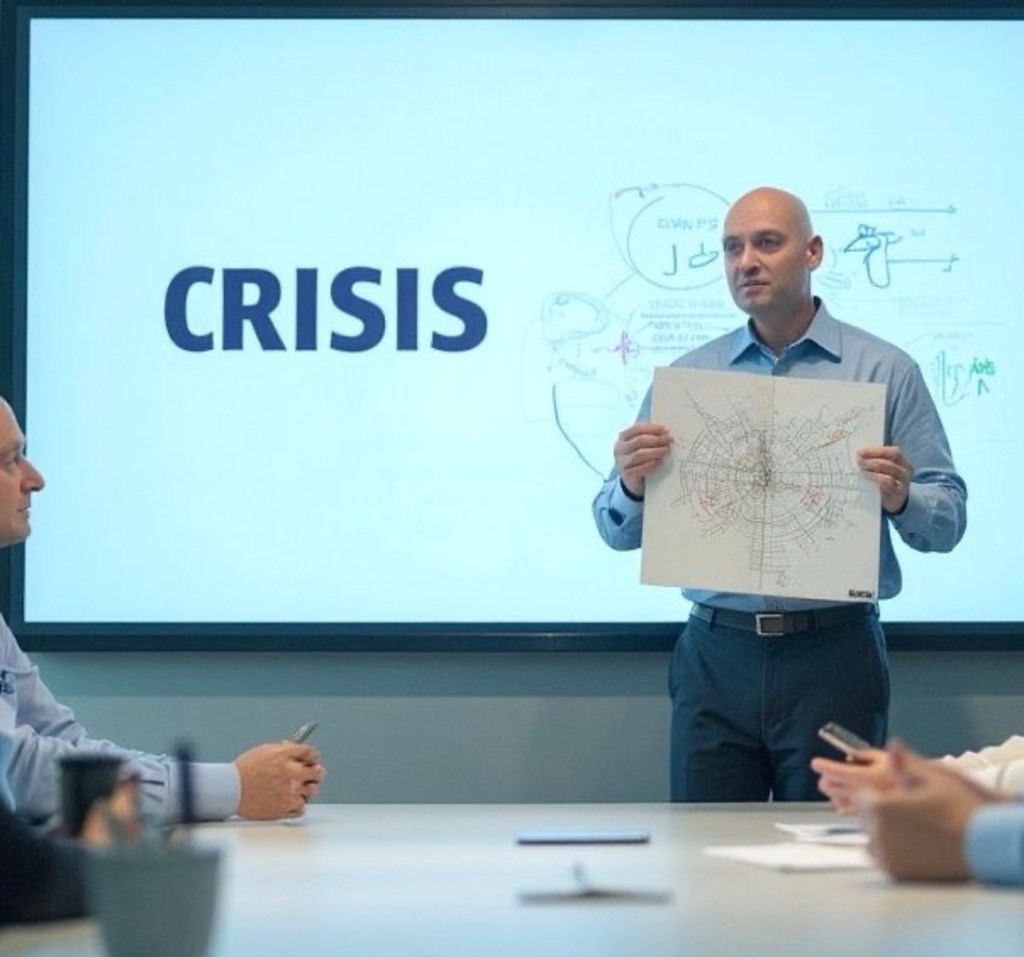
  • “Welcome to the Daily Crisis Club Manager’s Edition”

    Membership? Free.

    Enrollment? Automatic, the day you get the title.

    Activities? Live-action crises, ever-changing,

    with reruns scheduled at the most inconvenient times.

    You plan a calm day,

    knock out your to-do list,

    finally drink a cup of coffee while it’s still hot…

    and then life taps you on the shoulder and says:

    “Sweetheart, sit down. Let us show you what a real crisis looks like.”

    Here’s the greatest hits list:

    Business Crisis Your biggest client announces they’re moving to a competitor. (And just to spice it up… they do it at a press conference.)

    PR Meltdown A viral post on X (Twitter) with 300 shares: “Don’t buy from them look what I got!” Customer service lines are on fire, and your heart rate’s at 180.

    Health & Safety Scare Emergency call: “There’s a gas leak at the plant.” Of course, it’s the same day the CEO’s visiting for a tour.

    Cyberattack Morning: business as usual. By lunch: every screen flashes pink with a message “Pay in Bitcoin or kiss your files goodbye.”

    Operations Breakdown A truck with a critical shipment breaks down 120 miles from its destination. The driver? Not picking up. GPS? Says he’s in the middle of a cornfield.

    Financial Shock Monthly report. Bottom line in red. Very red. Almost as red as your face when you present it to the board.

    HR Bombshell Your team’s star performer quits. Effective Monday. No handover.

    Environmental Mess Heavy rain. Warehouse flooded. And then you discover “insurance” has a lot of fine print.

    Internal Reputation Hit Rumor spreads you’re leaving your role. (And you hear it first from the security guard in the lobby.)

    Innovation Flop New product launch. Customer feedback: “Oh… we already had this two years ago.”

    The tip?

    Crisis management isn’t about if, it’s about when.

    So expect them, build your playbook,

    and walk in with humor and a mindset that carries your whole team.

    Because if you’re stressed, they’re twice as stressed.

    But if you stay calm, they’ll know you can all get through it.

  • “She didn’t ask me to write this. But I just can’t stay quiet.”

    Every evening she comes home exhausted.

    She gives everything she has.

    Carries projects on her shoulders that would crush most people.

    And it’s not just performance.

    It’s brains, empathy, intuition, responsibility, big-picture thinking

    everything you’d want in a leader, she’s got it.

    But then the message comes:

    So-and-so got promoted.

    Not her.

    And it happens again.

    And again.

    She smiles.

    Says, “It’s okay.”

    That what really matters is working on something meaningful.

    That the title doesn’t matter as much as the impact.

    And me?

    I’m boiling inside.

    Because I see her worth.

    And I don’t understand

    why others can’t see it.

    Then I start to wonder:

    Maybe she doesn’t push herself forward enough?

    Maybe she doesn’t “market” herself?

    Maybe she just does the job too well,

    so it’s easier to keep her exactly where she is?

    But it hurts.

    Because I know it’s not her fault.

    And I also know

    that one day, they’ll finally wake up.

    And by then…

    it might be too late.

    My takeaway?

    Sometimes, to move up,

    it’s not enough to be amazing.

    You also have to remind people of it—without shame.

    Are you doing that?

  • A young, sharp manager sat across from me.

    “I want a promotion,” he said.

    “I’ve earned it. I work hard, I deliver results, I go above and beyond.”

    I listened. I nodded.

    Then I asked him one question:

    “Tell me, how do you think leaders actually make promotion decisions?”

    He went silent.

    Not because he didn’t know the answer

    but because he didn’t realize that was even the question.

    And that’s when I thought back to myself, years ago.

    When I wanted my very first promotion.

    And I felt like there was this glass wall I couldn’t break through.

    I was a good employee, well-regarded…

    but not “promotion material.”

    Why? I had no idea.

    So I did what most people do:

    Took another course. Worked even harder. Sacrificed more.

    And still couldn’t figure out why nothing was happening.

    Until I started asking different questions:

    Maybe I’m thinking like an employee, when I should be thinking like a leader. Maybe I’m trying to stand out in ways no one actually cares about. Maybe I’m pouring my energy into the wrong things. Or maybe, just maybe no one has ever shown me what the real path looks like.

    Since then, my work has been to uncover that path, step by step:

    How to think like the people who make the decisions. How to figure out what’s really holding you back. How to turn your everyday work into a quiet stage for influence. How to ask for a promotion, without apologizing or shrinking yourself. And how, once it happens, not to settle, but to ask, “What’s next? What’s the next level?”

    It’s not magic.

    And it’s definitely not luck.

    It’s a method. Pure and simple.

    פ

  • The Dishwasher Was Empty.

    But She Was Still Standing There.

    I was proud of myself.

    The dishwasher was empty.

    Dishes were clean. Counters wiped down.

    Just like in the commercials.

    Then my wife walked in.

    She looked around.

    Said nothing.

    Just stood there, hands on hips, eyebrows raised.

    You know the look.

    I smiled like a hero and said,

    “All done!”

    She didn’t smile back.

    She just tilted her chin toward the counter:

    “What about that?”

    And yeah…

    The counter did look like someone made a tuna sandwich in the dark.

    But in my head?

    Not my problem.

    I had a task: dishwasher.

    Mission accomplished.

    Then she hit me with this:

    “You’re not taking a math test.

    It’s not about what was assigned.

    It’s about seeing the whole picture.”

    Boom.

    Right there, holding a dish towel in one hand and a coffee cup in the other,

    I saw it all.

    My team.

    My coworkers.

    The familiar phrases:

    “That’s not my responsibility.”

    “I did my part.”

    “No one told me…”

    And it hit me

    That’s the difference between an employee and a leader.

    Employees wait for assignments.

    Leaders notice what’s needed.

    Sure, the dishwasher was empty.

    But my brain?

    It was full.

    Because I finally understood:

    It doesn’t matter how well you executed your task

    if you missed the bigger picture.

    Since that day at home and at work

    I stopped asking “What was I told to do?”

    And started asking:

    “What’s really needed right now?”

    Ever had one of those moments where you were so focused on the task,

    you forgot to look up and see the full picture?

  • Quick change? That only works in a microwave.

    Consultants flew in from overseas.

    Slick slides.

    A big vision.

    A one-year plan and voilà! Operational excellence.

    Sounds impressive, right?

    But then I looked around.

    My people were barely keeping up with the day-to-day.

    Line breakdowns.

    Customers pushing hard on the phone.

    Marketing pushing discounts.

    Sales making promises we couldn’t deliver on.

    And in the middle of all that?

    Learn a whole new system?

    Change the entire workflow?

    Achieve excellence?

    I told myself:

    “They saw the plan.

    I see the people.”

    And I really saw them.

    Running from meeting to email,

    Exhausted. Confused. Stressed.

    Going through the motions of change just trying to survive the day.

    So I did something no management book teaches.

    I opened the contract.

    I scaled back the consulting.

    And I extended the timeline by a year and a half.

    Yes, a year and a half.

    Because real change doesn’t happen under pressure.

    There are no magic tricks.

    You can’t buy it in a deck of slides.

    Real change happens

    when the pace matches the heartbeat of your organization.

    Ever tried to push a change too fast

    and the system just spit it back out?

  • Got a “good” question? Ask it.

    Even if you’re the manager.

    Especially if you’re the manager.

    You know that moment in a meeting when someone drops a term…

    And your whole body signals:

    “Of course. Of course I know what CAC is. I’m the manager, after all.”

    But your mind goes:

    “If someone shouts at me right now ‘What’s CAC?’ – I’ll just head out for a coffee break and never come back.”

    So you smile, jot something down in your notebook (even though you have no idea what you wrote),

    And later that evening, you ask Google.

    Or your kid.

    Or ChatGPT.

    And that’s exactly the moment you missed the chance to be a more human manager.

    Because the gap wasn’t in knowledge it was in the courage to ask.

    A simple question like:

    “Could you explain that for a second?”

    Can change the entire dynamic of a meeting.

    It shows you’re not projecting authority based on bravado – but trust.

    And it gives others permission to ask too.

    And in an age where even a dishwasher can define “digital marketing,”

    What sets you apart isn’t what you know.

    It’s your willingness to keep learning.

    And by the way? I have no idea what CAC is either.

    But I’m going to ask the chat.

    What’s worth remembering?

    The one who asks doesn’t look less smart.

    They just look like a sane manager.